
Research
We focus on the synthesis and development of polymers with well-defined functionality, composition, and molecular architecture, employing basic organic transformations to create, functionalize, and deconstruct new macromolecular materials.


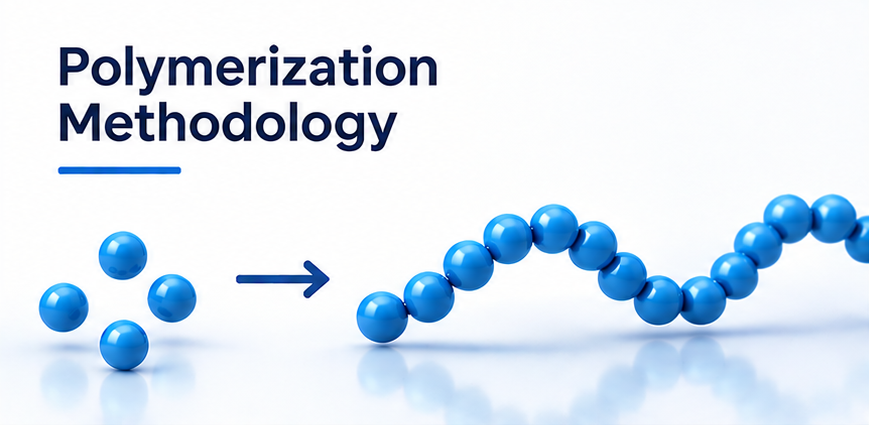
Polymerization Methodology
Through precision synthesis via controlled polymerization, we create macromolecules with well-defined features. We focus on developing new polymerization routes to achieve polymers with exceptional control over molecular weight, functionality, and architecture. We have advanced chain polymerization techniques to attain ultra-high molecular weights previously thought unreachable, developed new routes to graft polymers from proteins, and utilized unique organic transformations to develop distinctive step-growth polymers.
Selected publications
RAFT with Light: A User Guide to Using Thiocarbonylthio Compounds in Photopolymerizations
ACS Polym. Au 2025, 5, 184–213
Ultra-High Molecular Weight Triblock Copolymers via Inverse Miniemulsion Photoiniferter Polymerization
Macromolecules 2024, 57, 4007–4015
Democratization of Sono-RAFT: Reversible-Deactivation Radical Polymerization with Low-Frequency Ultrasound
Macromolecules 2023, 56, 9350–9358
Excitation Dependence in Photoiniferter Polymerization
ACS Macro Lett. 2023, 12, 14–19
Hybrid Block Copolymer Synthesis by Merging Photoiniferter and Organocatalytic Ring-Opening Polymerizations
Angew. Chem. Int. Ed. 2021, 60, 18537–18541
Cyclic Polyacetylene
Nat. Chem. 2021, 13, 792–799

Polymer Transformations
We leverage fundamental advances in organic synthesis to introduce functionality and create polymers that are not easily synthesized by other means. Highly efficient post-polymerization modification is essential to incorporate functionalities that are difficult to include in monomers, initiators, or chain transfer agents. Many chemical transformations used in organic synthesis lack the efficiency and orthogonality required for functionalizing high molecular weight macromolecules. Consequently, our group has dedicated significant effort to developing organic methodologies for functional polymer synthesis.
Selected publications
Redox-Selective Macromolecular Electrolysis for Sequential Functionalization and Deconstruction
J. Am. Chem. Soc. 2025, 147, 8398–8405
Retrofitting PMMA with a Thermal Trigger for Efficient Depolymerization
J. Am. Chem. Soc. 2025, 147, 19485–19490
Selective Electrochemical Modification and Degradation of Polymers
Angew. Chem. Int. Ed. 2024, 63, e202403026
Diversification of Acrylamide Polymers via Direct Transamidation of Unactivated Tertiary Amides
J. Am. Chem. Soc. 2024, 146, 1627–1634
Degradation of Polyacrylates by One-Pot Sequential Dehydrodecarboxylation and Ozonolysis
J. Am. Chem. Soc. 2023, 145, 10480–10485
Photocatalytic Direct Decarboxylation of Carboxylic Acids to Derivatize or Degrade Polymers
Angew. Chem. Int. Ed. 2022, 61, e202209085
Macromolecular Self-Assembly
The ability to prepare block copolymers with segments of varying solubility enables us to investigate self-assembly as a mechanism to create polymer nanoparticles for applications in drug delivery, coatings, energy, and self-healing materials. By precisely controlling the molecular weight, functionality, and architecture of these block copolymers, we can tune the size and shape of the supramolecular assemblies in predictable ways. Our research has demonstrated that self-assembly is not merely an end goal, but a process that can be exploited to achieve synthetic outcomes unattainable under homogeneous conditions. Thus, self-assembly serves as a powerful tool driving innovative synthesis.

Selected publications
Ultra-High Molecular Weight Polymer Synthesis via Aqueous Dispersion Polymerization
Chem. Sci. 2025, 16, 5573–5578
Divergent Photoiniferter Polymerization-Induced Self-Assembly
Polym. Chem. 2025, 16, 620–625
Synthetic Micromorphologies through UHMW Complex Coacervation via Polymerization-Induced Electrostatic Self-Assembly
Polym. Chem. 2024, 15, 1821–1825
Ultrafast Xanthate-Mediated Photoiniferter PISA
Angew. Chem. Int. Ed. 2023, 62, e202309951
Controlling Morphological Transitions of Polymeric Nanoparticles via Doubly-Responsive Block Copolymers
Macromolecules 2023, 56, 3316–3323
Gradient Copolymer Synthesis through Self-Assembly
ACS Macro Lett. 2023, 12, 454–461
Janus Cross-links in Supramolecular Networks
J. Am. Chem. Soc. 2022, 144, 845–853

Novel Materials & Applications
Our ability to prepare well-defined polymers with controlled macromolecular features enables us to target diverse materials for applications in medicine, defense, energy, and sustainability. We have developed polymers that mimic natural biomacromolecules and deliver small-molecule therapeutics at controlled rates or specific locations in vivo. Our research also focuses on thermally conductive polymers and self-healing materials. Importantly, we leverage fundamental polymer chemistry to address the plastics waste problem by developing innovative routes for polymer degradation and depolymerization.
Selected publications
Selective Depolymerization for Sculpting Polymethacrylate Molecular Weight Distributions
J. Am. Chem. Soc. 2025, 147, 5220–5227
In-situ Monitoring of Droplet Behavior in Inverse Microemulsions
ACS Nano 2025, 19, 19168–19176
Intrinsically Thermally Conductive Polymers
Mater. Horiz. 2024, 11, 3267–3286
Bulk Depolymerization of Methacrylate Polymers via Pendent Group Activation
J. Am. Chem. Soc. 2024, 146, 6217–6224
Improved Comonomer Reactivity Enhances Optical Clarity and Mechanical Properties of pH-Independent Synthetic and Mucin-Crosslinked Boronic Acid Hydrogels
Macromolecules 2024, 57, 887–893
Bulk Depolymerization of Poly(Methyl Methacrylate) via Chain-End Initiation for Catalyst-Free Reversion to Monomer
Chem 2023, 9, 2669–2682